
Agribusiness Project Manager

Wishlist Share

About Course

An agribusiness project can involve farmers, suppliers, staff, partners and deadlines that all depend on one another. A project manager keeps the work organised and helps the team deliver what was promised.
In this course, learners will practise turning a project goal into a work plan, assigning responsibilities, setting timelines and budgets, tracking progress and reporting results. They will also learn to identify risks early, manage changes and communicate clearly with the people involved. Activities will use examples from farm operations, food processing and agricultural training programmes.
The course is designed for aspiring project managers and agribusiness professionals who coordinate activities across people, locations and organisations.

Show More

What Will You Learn?

  • Write a project brief with a clear problem and boundary
  • Identify people affected and the decisions they influence
  • Define deliverables, exclusions and acceptance evidence
  • Sequence tasks and calculate a simple dependency network
  • Build a quantity-and-rate estimate with clear assumptions
  • Distinguish a risk from an issue and an assumption
  • Prepare a clear purchase requirement and comparison basis
  • Run short meetings that end with owners and actions
  • Measure accepted progress using defined evidence
  • Choose a delivery approach that fits uncertainty and constraints
  • Prepare an accepted handover with open items and owners
  • Match role descriptions to your evidence and authority

Course Content

Module 1: Turn an Agribusiness Idea into a Clear Project
A cooperative wants a collection point ready before its next buying cycle. Everyone agrees it is important, but nobody agrees what ready means. Where would you begin? Write a project brief with a clear problem and boundary. Build a practical work sample that connects to the next module.

  • Lesson 1: Introduction
  • Lesson 2: Turn an Agribusiness Idea into a Clear Project
    06:00
  • Lesson 3: From Idea to Approved Brief
  • Lesson 4: Visual Guide
  • Lesson 5: Discussion
  • Module 1 Knowledge Check

Module 2: Work with Stakeholders and Set Clear Decision Roles
The proposed training time suits the office team but clashes with farmers’ collection work. A good plan on paper is beginning to lose the people who need it. Identify people affected and the decisions they influence. Build a practical work sample that connects to the next module.

Module 3: Define Scope and Break the Work into Manageable Pieces
A crate supplier says delivery means the job is finished. The receiving team says the crates must also meet the agreed specification. The project needs a shared meaning of done. Define deliverables, exclusions and acceptance evidence. Build a practical work sample that connects to the next module.

Module 4: Build a Schedule That Respects Dependencies and Seasons
The collection-point launch date has been announced, but operator practice cannot start until the records are ready. The schedule must show what waits for what. Sequence tasks and calculate a simple dependency network. Build a practical work sample that connects to the next module.

Module 5: Estimate Costs and Keep Budget Cash and Forecast Separate
The project has an approved budget, but the team cannot pay the next invoice. The problem is cash timing, and a budget total will not explain it. Build a quantity-and-rate estimate with clear assumptions. Build a practical work sample that connects to the next module.

Module 6: Manage Risks Issues Assumptions and Dependencies
The delivery route may become inaccessible after heavy rain. A different supplier has already missed a promised confirmation. These need different kinds of follow-up. Distinguish a risk from an issue and an assumption. Build a practical work sample that connects to the next module.

Module 7: Procure What the Project Actually Needs
The lowest quotation leaves out transport and does not describe the crate specification. Choosing a supplier now could create an expensive surprise later. Prepare a clear purchase requirement and comparison basis. Build a practical work sample that connects to the next module.

Module 8: Coordinate Delivery and Control Changes
A sponsor asks for an extra service just before launch. The team wants to help, but adding it quietly would change both the finish date and the budget. Run short meetings that end with owners and actions. Build a practical work sample that connects to the next module.

Module 9: Check Quality and Report Progress with Evidence
Five milestones were due this week. Four were accepted on time, while the fifth was delivered but failed its agreed test. Calling all five complete would mislead the sponsor. Measure accepted progress using defined evidence. Build a practical work sample that connects to the next module.

Module 10: Adapt Delivery to Farming Processing Service and Agtech Projects
A receiving-log pilot works in the office but fails when the collection point has poor connectivity. The next step is to learn from the pilot before expanding it. Choose a delivery approach that fits uncertainty and constraints. Build a practical work sample that connects to the next module.

Module 11: Hand Over Close and Check the Benefits
The project team is ready to leave. The records and crates are in place, but nobody has agreed who will manage support requests or check whether receiving delays improve. Prepare an accepted handover with open items and owners. Build a practical work sample that connects to the next module.

Module 12: Show Your Skills and Build a Career in Project Work
An employer asks what you can actually manage. You have a course certificate, but the strongest answer is a clear work sample you can explain honestly. Match role descriptions to your evidence and authority. Build a practical work sample that connects to the next module.

Cumulative Project and Career Submission

Module 13: Agribusiness Project Decisions Final Examination
A dedicated assessment module bringing together scope, scheduling, cost, risks, suppliers, change and evidence. 20 multiple-choice questions at 1 mark= 20. Keep answers staff-only. Use owner-approved attempts and pass rules.

Other and Further Learning Resources

Earn a certificate

Add this certificate to your resume to demonstrate your skills & increase your chances of getting noticed.
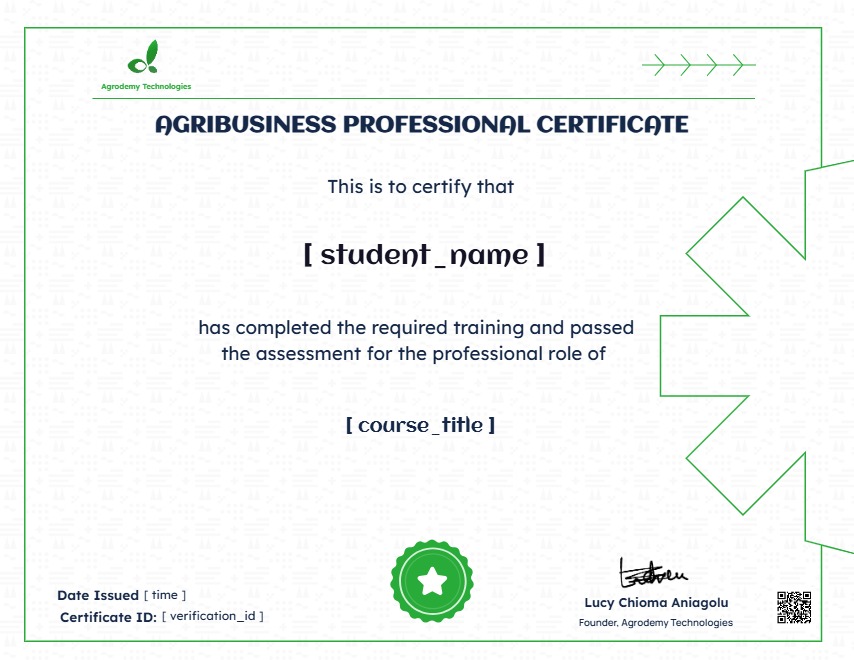
selected template

Student Ratings & Reviews

No Review Yet
No Review Yet

Want to receive push notifications for all major on-site activities?

✕
Select your currency
NGN Nigerian naira
Scroll to Top